Saturday, February 26, 2011

Pirates of the Meandering Sea
The Apa Sirviciul Alcovia (ASA) - Part One


Invasion barges assemble on the Alcovian side of the Borka during preparation for the counter-offensive following the invasion of 1854.
 

The border between eastern Alcovia and western Iqenistan is a 500 mile stretch of the river Borka. Snaking its way out of the Capaccian Mountains the stretch where the two neighboring nations meet is known to Alcovians as the "Meandering Sea", a name derived from the wide, slow-moving and twisting waters of the Borka. It is along this watery span that Alcovia's flotilla of river boats, gunboats and monitors patrols, keeping a vigil against invasion from the east.


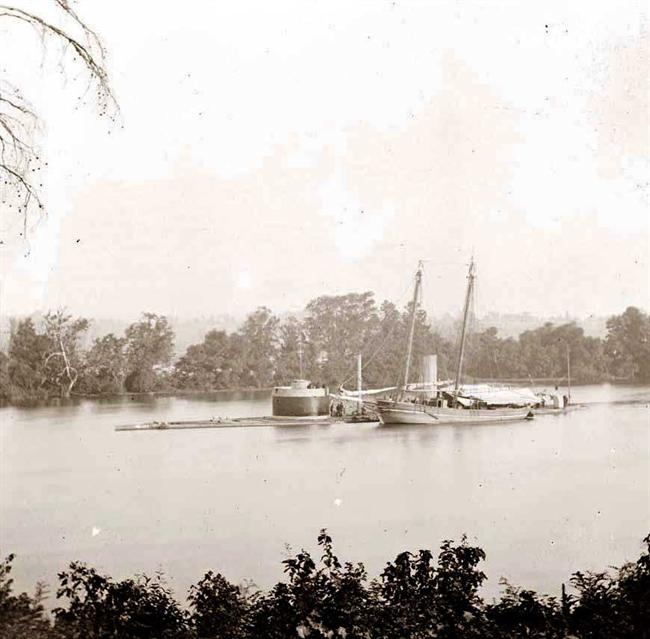
An early Alcovian river monitored, based off of American Civil War designs.
 
Since the mid-nineteenth century, Alcovia has endeavored to maintain their presence on these waters, following the invasions of 1832 and 1854 when large sections of eastern Alcovia were seized and occupied by Iqenistani troops. Since their repulsion and the reclamation of those territories, a steady program of acquisition and production of vessels suitable for river patrol and fresh water naval bombardment has been a major priority. Beginning with the purchase and importation of foreign vessels, and later by the construction of native vessels, often copied or under license from foreign shipyards, Alcovia now boasts a sizable river flotilla of some 150 vessels ranging in size and type from small coal-fueled patrol steamers to fully armored gunboats boasting multiple turrets.


Alcovian customs and border patrol vessel. This vessel is a conversion of a civilian river craft carrying light guns and a contingent of ASA border marines. Known affectionately by their crews as "Pirate Brigs".
 
Service in the Apa Sirviciul Alcovia, is considered a service for cutthroats and desperate men. Operating far from the capital and with a great degree of autonomy, the sailors of this branch of Alcovian service are known for their brash, often loose adherence to the law. They are also renowned for a certain roguish nature and lack of couth that more “civilized” circles often find distasteful. For these reasons, ASA servicemen spend little time in central or western Alcovia and usually hail from the rougher eastern towns and villages who have a history of river piracy, wrecking and smuggling. In fact, many Alcovian sailors aren’t even from Alcovia at all, having been either pressed or recruited into service from foreign nations or from foreign vessels plying the Borka.

These foreign servicemen are most often confined to the ASA special border marines. Specializing in trans-riverine operations, hit and run and interdiction, these men are often sent on strike missions against targets across the river and into Iqenistani territory. These men are hard, often veterans or deserters from other country’s armed forces who pride themselves on their craftiness, skill in combat and the die hard attitudes. One of their most famous mission to date was the storming of the river town of Kuzbhani in 1916 at the southern tip of the Iqenistani/Alcovian border where some 150 border marines rescued Countess Natavya Kishinug, daughter of king Ilya’s brother Vitali Chubakov.


A modern Alcovian "Bortha" class river monitor sporting two 15cm guns in a forward turret. Six of these vessels built between the years of 1915 and 1925.


APA patrol boat, hidden under tree limbs
 and other foliage along the river bank.
The princess had been abducted as a political prisoner when her private yacht was forced to dock in Kuzbhani after experiencing engine troubles on its return from the Black Sea. The military garrison commander of Kuzbhani, Rikan Alabash, had seized her from the residence of the city’s mayor Ulmor Fedaha. Alabash had hoped to use her as a bargaining chip in his own military and political agendas. When the border marines were through with their mission, however, Alabash was slain and the garrison of Kuzbhani devastated.

In the aftermath of this brief conflict, Fedaha insisted that Iqenistan not use this as an excuse for war by his people in a very public display of regret at the actions of his countryman, Alabash. In this operation, only three border marines were killed, all of their bodies returned to Alcovia where they were entombed as national heroes and the reputation of the border marines was reaffirmed and their national character established as the go-to men for dirty jobs.


Thursday, February 24, 2011

Future Heroes of Alcovia

News Archive - November 24, 1923

Urban youngsters throughout Alcovia participate in state sponsored and supervised clubs that teach them the basics of combat and warfare. Diguised as scouting and club activities, the activities included in these groups instruct the children and youth of urban Alcovians in such elementary military staples as small unit tactics, field craft, as well as marksmanship in the various city rifle competitions.

As Alcovia has not the means for a true military academy, these boys clubs are the closest that young boys will ever get to an academic military education. Any Alcovian aristocrat that wishes a true academy education must travel abroad. In fact most of the Alcovian nobility have received their military educations in foreign lands, a practice that Alcovian nobility sees as akin to the ancient practices of fostering - creating bonds with other nations through its children.

Right: Rubel Yugolev seen leading his mean in a march to defend Alcovia's eastern borders from Iqenistani raiders.


Still, the basic education in the art of war instilled in Alcovian children and youths in these clubs is much more than some other nations have to offer and the skills learned there can make the difference between being just another poor conscript and the leader of such men. Many Alcovian lieutenants are conscripts that have a history in these organizations. At least one national hero, Rubel Yugolev, was a member of the renowned Kuslob Flag and Rifle Team.

Wednesday, February 23, 2011

Early Armor in Alcovia


The late Alcovian King Ilya Chubakov (1847-1920) and his heirs Ilya II, Ukko and Ullo were known for their fondness for armored vehicles. Ever since Ilya I saw their birth in Great War it had become his dream to one day hear the rumble and rattle of armored might crawling across Alcovia towards her enemies. Unfortunately, financial strife and a low technological base hampered Ilya's dreams beyond a few surplus German tanks, but it was a dream that burned on in his sons Ukko and Ullo.

In 1922, Prince Ukko, working with a conglomerate of Alcovian and Elistonian businessmen and a number of foreign investors, gambled on an enterprise to acquire several copies of foreign tanks for study by Alcovian engineers. The intent was to determine what designs were within the realm of possibility for the small nation both economically and technologically. If designs could be found that were within Alcovia's means, Ukko intended to begin production, either licensed or illegally, for the purposes of both national defense and export.


After considering several designs, Ukko's agents settled upon the now quite common FT-17 as a standard tank for use by the Alcovian military. The FT-17 was a widely used tank and Ukko figured that it would be nearly impossible for Alcovia to be cut off from supplies of parts and new vehicles until it was able to produce on its own. FT-17s were imported from a number of sources including France and Poland and were designated the TA22 for Tankovya Alcovia, Model 1922. In total, 35 of these tanks were initially imported.

By 1924, Alcovia had two factories manufacturing TA22s in both their original and the new TA22/24 which was a new version with more horsepower. In total, 54 TA22s and 32 TA22/24 tanks were built before the Royal Armories developed newer vehicles to phase out the FT-17 derived tanks. TA22s were never completely abandoned and continued in service into the 1940s in reserve roles.

Tuesday, February 22, 2011

Blog on Hold

Sorry to do this folks, but it's become obvious that the Alcovia project is progressing slower than I had hoped. As such, I am going to declare this blog on hold for the time being.

Why?

I could continue to post news bites about the conflict and I'm sure that would be fun, but in doing so, I would end up telling so much of the story that by the time I got miniatures on the table there would be little story left to tell.

The project is not dead and I'm still going to be working on models and miniatures as I can, but until I have something more material to show, I'm not going to be doing a lot of the fluff posts here.

Please stay tuned and Alcovia will be back when I can put more time into it.

Thanks!

-Eli

Tuesday, February 1, 2011

NAA Launches Strike Against Rebel Stronghold

February 1, 2011

In what has now been named the largest military operation in the Alcovian Civil War, National Alcovian Army forces launched a massive strike against the west-most rebel stronghold in the Tovil Valley around the city of Bumrusk. Bumrusk  is home to one of the largest military bases to join in with General Kusatya when he declared independence from the Alcovian monarchy and set over 30% of the nation's armed forces against its own government.


After almost two months of positioning and blockading, NAA forces were given the order to commence attacks with long-range assets when the commander of the Bumrusk Army Base refused to stand down and cease his resupply operations of smaller rebel units operating in the area. It has also been suggested, though nothing officially confirms it, that Bumrusk base has been supplying non-military rebel militias.

Helicopter and artillery strikes were unleashed in an unending assault, lasting from day break to dusk, designed mostly to demoralize rebel forces. Targets were intentionally limited to depots and support structures by direct command from the King who still maintains hopes to limit the bloodshed in the escalating conflict. Still, the inaccuracies of artillery and the proximity of some intended targets to structures to be spared has resulted in some reported 150 dead and an undisclosed number of injured.


Though the commander of the attacking NAA forces was not available to comment, it has been suggested that national forces commanders are blaming the APA for the elevated casualty count and not their own abilities. There is little, hover,  to suggest that rebel commanders have changed the arrangement of the base since declaring their independence so any inaccuracies in long-range strikes can only be attributed to the men and equipment at their source.


Monday, January 24, 2011

[USE ME] Alcovian Motor Rifle Troops

After my impromptu solo game using the USE ME system, I took some time today to write out some proper unit write-ups with points values to demonstrate, to those who may not be familiar, how USE ME looks on a stats level.

The system is intended to be incredibly generic and really simple, fitting into the tiniest little rule book you will ever see in official print - about the same dimensions as a typical miniatures blister pack. There are only three kinds of vehicles in USE ME and the ability to armor them or not. The weapons are expressed as a matter of broad categories. Interpreting specific equipment and vehicles often requires a bit of squinting to blur the particulars.

For the purposes of this first run, I decided that I would categorize armored vehicles thus - APCs would count as Light, medium tanks would be Heavy and anything in the category of an Abrams or Challenger would be Super Heavy. A bit of wiggling can be achieved here by the decision to classify a vehicle as armored or not. A URAL or UAZ is a Light vehicle but unarmored. The difference between a T-55 and a T-72 could be that a T-55 is a Heavy and a T-72 is an Armored Heavy. Vague differences to be sure, but this isn't a nuts and bolts game.

Listed below are some of the write-ups for the National Alcovian Army forces used in the scenario.


BTR-70 APC (Armored Light Vehicle) – 25pts
Elan: 3                   Move: 12”
Attack Type:          Vehicle Automatic Weapon (Autocannon)

Soldier (Infantry) – 10pts
Elan: 3                   Move: 4”
Attack Type:          Superior Rifle (AK)

SAW (Infantry) – 11pts
Elan: 3                   Move: 4”
Attack Type:          Heavy Weapon (RPK)

RPG Team (Infantry) – 24pts
Elan: 3                   Move: 4”
Attack Type:          Direct Support Weapon (RPG)
                               Superior Rifle (AK)

Captain Irengutz (Infantry Hero) – 20pts
Elan: 5                   Move: 4”
Attack Type:          Superior Rifle (AK)
                               Sidearm

Sunday, January 23, 2011

Prisoners Taken in New Year's Fighting

January 23, 2011


News of fighting in the eastern city of Bunchabal has been confirmed.

While patrolling through the small city, NAA forces came under sudden attack, ambushed by APA infantry that had taken up positions in the ten stories, this elevation provided plenty of positions for the attacking snipers and rockets that rained down on national forces. It was only the quick thinking and maneuvering of unit's commander Captain Yubel Irengutz that prevented the attack from being a massive catastrophe for his unit.

Captain Irengutz maneuvered his light vehicle under the cover of a nearby parking structure where he created a defensive position from which to return fire and give himself time to evaluate the situation. Once in position, the brave NAA captain was able to locate the main enemy positions and direct concentrated fire on those locations. This provided covering fire for him to deploy two small teams of soldiers to outflank the ambushers.

Several NAA soldiers were injured in the ensuing firefight as the fire teams moved through several floors of the surrounding buildings, guided by Captain Irengutz and his radio operator who called out the positions of various sniper and rocket teams as they were pinpointed. Rooftop snipers where eventually taken out by helicopter strikes as the captain was finally able to call in support from a nearby patrol.


After nearly nine hours of continuous fighting, NAA forces were able to secure the area. Exact numbers of dead have not been released at this time, but it is known that several prisoners were taken, junior officers and NCOs in the APA. The firefight also provided additional evidence to the growing number of civilian volunteers and militia groups that are becoming involved in the conflict. No civilian prisoners were taken as all either perished in the fighting or took their own lives rather than be captured.

[This is a newscast summary of a simple solo game I played using the USE ME rules by 15mm.co.uk.. Though intended for use with science fiction miniatures, the rules are incredibly simple and lent themselves well to an ad hock game. As I do not have my 20mm stuff ready yet, this was played with existing 15mm figs from my collection with books and boxes standing in for proper buildings. Very fun nonetheless, but not overly photogenic.]